
Module 7 Practice Problems
Definitions
- Define solute and solvent.
-
Define saturated, unsaturated, and supersaturated.
-
A solution is prepared by combining 2.09 g of CO2 and 35.5 g of H2O. Identify the solute and solvent.
-
A solution is prepared by combining 10.3 g of Hg(ℓ) and 45.0 g of Ag(s). Identify the solute and solvent.
- Use the associated table to determine the following: decide if a solution containing 45.0 g of NaCl per 100 g of H2O is unsaturated, saturated, or supersaturated.
Solute Solubility (g per 100 g of H2O at 25°C) AgCl 0.00019 CaCO3 0.0006 KBr 70.7 NaCl 36.1 NaNO3 94.6 - Use the table in question 5 to determine the following: decide if a solution containing 0.000092 g of AgCl per 100 g of H2O is unsaturated , saturated, or supersaturated.
- Would the solution in Exercise 5 be described as dilute or concentrated? Explain your answer.
- Would the solution in Exercise 6 be described as dilute or concentrated? Explain your answer.
- Identify a solute from the table in question 5 – Solubilities of Some Ionic Compounds, whose saturated solution can be described as dilute.
- Identify a solute from the table in question 5 – Solubilities of Some Ionic Compounds, whose saturated solution can be described as concentrated.
- Which solvent is Br2 more likely soluble in—CH3OH or C6H6?
- Which solvent is NaOH more likely soluble in—CH3OH or C6H6?
- Compounds with the formula CnH2n + 1OH are soluble in H2O when n is small but not when n is large. Suggest an explanation for this phenomenon.
- Glucose has the following structure:
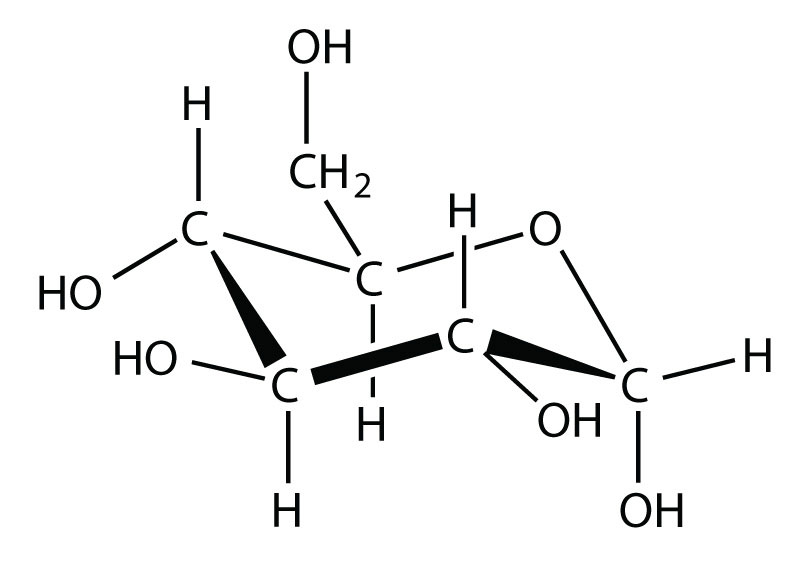
What parts of the molecule indicate that this substance is soluble in water?
Quantitative Units of Concentration
- Differentiate between molarity and molality.
- Differentiate between mass percentage and parts per thousand.
- What is the molarity of a solution made by dissolving 13.4 g of NaNO3 of in 345 mL of solution?
- What is the molarity of a solution made by dissolving 332 g of C6H1206 of in 4.66 L of solution?
- How many moles of MgCl2 are present in 0.0331 L of a 2.55M solution?
- How many moles of NH4Br are present in 88.9 mL of a 0.228M solution?
- What volume of 0.556M NaCl is needed to obtain 0.882 mol of NaCl?
- What volume of 3.99M H2SO4 is needed to obtain 4.61 mol of H2SO4?
- What volume of 0.333M Al(NO3)3 is needed to obtain 26.7g of Al(NO3)3?
- What volume of 1.772M BaCl2 is needed to obtain 123 g of BaCl2?
- What are the individual ion concentrations and the total ion concentration in 0.66M Mg(NO3)2?
- What are the individual ion concentrations and the total ion concentration in 1.04M Al2(SO4)3?
- If the C2H3O2– ion concentration in a solution is 0.554M, what is the concentration of Ca(C2H3O2)2?
- If the Cl– ion concentration in a solution is 2.61M, what is the concentration of FeCl3?
Concentrations as Conversion Factors
- Using concentration as a conversion factor, how many moles of solute are in 3.44 L of 0.753 M CaCl2?
-
Using concentration as a conversion factor, how many moles of solute are in 844 mL of 2.09 M MgSO4?
-
Using concentration as a conversion factor, how many liters are needed to provide 0.822 mol of NaBr from a 0.665 M solution ?
-
Using concentration as a conversion factor, how many liters are needed to provide 2.500 mol of (NH2)2CO from a 1.087 M solution?
-
What is the mass of solute in 24.5 mL of 0.755 M CoCl2?
-
What is the mass of solute in 3.81 L of 0.0232 M Zn(NO3)2?
-
What volume of solution is needed to provide 9.04 g of NiF2 from a 0.332 M solution?
-
What volume of solution is needed to provide 0.229 g of CH2O from a 0.00560 M solution?
-
What volume of 3.44 M HCl will react with 5.33 mol of CaCO3?
-
2HCl + CaCO3 → CaCl2 + H2O + CO2
-
-
What volume of 0.779 M NaCl will react with 40.8 mol of Pb(NO3)2?
-
Pb(NO3)2 + 2NaCl → PbCl2 + 2NaNO3
-
-
What volume of 0.905 M H2SO4 will react with 26.7 mL of 0.554 M NaOH?
-
H2SO4 + 2NaOH → Na2SO4 + 2H2O
-
-
What volume of 1.000 M Na2CO3 will react with 342 mL of 0.733 M H3PO4?
-
3Na2CO3 + 2H3PO4 → 2Na3PO4 + 3H2O + 3CO2
-
- It takes 23.77 mL of 0.1505 M HCl to titrate with 15.00 mL of Ca(OH)2. What is the concentration of Ca(OH)2? You will need to write the balanced chemical equation first.
- It takes 97.62 mL of 0.0546 M NaOH to titrate a 25.00 mL sample of H2SO4. What is the concentration of H2SO4? You will need to write the balanced chemical equation first.
-
It takes 4.667 mL of 0.0997 M HNO3 to dissolve some solid Cu. What mass of Cu can be dissolved?
-
Cu + 4HNO3(aq) → Cu(NO3)2(aq) + 2NO2 + 2H2O
-
-
It takes 49.08 mL of 0.877 M NH3 to dissolve some solid AgCl. What mass of AgCl can be dissolved?
-
AgCl(s) + 4NH3(aq) → Ag(NH3)4Cl(aq)
-
-
What mass of 3.00% H2O2 is needed to produce 66.3 g of O2(g)?
-
2H2O2(aq) → 2H2O(ℓ) + O2(g)
-
- A 0.75% solution of Na2CO3 is used to precipitate Ca2+ ions from solution. What mass of solution is needed to precipitate 40.7 L of solution with a concentration of 0.0225 M Ca2+(aq)
- Na2CO3(aq) + Ca2+(aq) → CaCO3(s) + 2Na+(aq)
Dilutions and Concentrations
- What is the difference between dilution and concentration?
- What quantity remains constant when you dilute a solution?
- A 1.88 M solution of NaCl has an initial volume of 34.5 mL. What is the final concentration of the solution if it is diluted to 134 mL?
- A 0.664 M solution of NaCl has an initial volume of 2.55 L. What is the final concentration of the solution if it is diluted to 3.88 L?
- If 1.00 mL of a 2.25 M H2SO4 solution needs to be diluted to 1.00 M, what will be its final volume?
- If 12.00 L of a 6.00 M HNO3 solution needs to be diluted to 0.750 M, what will be its final volume?
- If 665 mL of a 0.875 M KBr solution are boiled gently to concentrate the solute to 1.45 M, what will be its final volume?
- If 1.00 L of an LiOH solution is boiled down to 164 mL and its initial concentration is 0.00555 M, what is its final concentration?
- How much water must be added to 75.0 mL of 0.332 M FeCl3(aq) to reduce its concentration to 0.250 M?
- How much water must be added to 1.55 L of 1.65 M Sc(NO3)3(aq) to reduce its concentration to 1.00 M?
