
2: Culture
Culture
By Robert Biswas-Diener and Neil Thin Portland State University, University of Edinburgh
Although the most visible elements of culture are dress, cuisine and architecture, culture is a highly psychological phenomenon. Culture is a pattern of meaning for understanding how the world works. This knowledge is shared among a group of people and passed from one generation to the next. This module defines culture, addresses methodological issues, and introduces the idea that culture is a process. Understanding cultural processes can help people get along better with others and be more socially responsible.
Learning Objectives
- Appreciate culture as an evolutionary adaptation common to all humans.
- Understand cultural processes as variable patterns rather than as fixed scripts.
- Understand the difference between cultural and cross-cultural research methods.
- Appreciate cultural awareness as a source of personal well-being, social responsibility, and social harmony.
- Explain the difference between individualism and collectivism.
- Define “self-construal” and provide a real life example.
Introduction
When you think about different cultures, you likely picture their most visible features, such as differences in the way people dress, or in the architectural styles of their buildings. You might consider different types of food, or how people in some cultures eat with chopsticks while people in others use forks. There are differences in body language, religious practices, and wedding rituals. While these are all obvious examples of cultural differences, many distinctions are harder to see because they are psychological in nature.

Just as culture can be seen in dress and food, it can also be seen in morality, identity, and gender roles. People from around the world differ in their views of premarital sex, religious tolerance, respect for elders, and even the importance they place on having fun. Similarly, many behaviors that may seem innate are actually products of culture. Approaches to punishment, for example, often depend on cultural norms for their effectiveness. In the United States, people who ride public transportation without buying a ticket face the possibility of being fined. By contrast, in some other societies, people caught dodging the fare are socially shamed by having their photos posted publicly. The reason this campaign of “name and shame” might work in one society but not in another is that members of different cultures differ in how comfortable they are with being singled out for attention. This strategy is less effective for people who are not as sensitive to the threat of public shaming.
The psychological aspects of culture are often overlooked because they are often invisible. The way that gender roles are learned is a cultural process as is the way that people think about their own sense of duty toward their family members. In this module, you will be introduced to one of the most fascinating aspects of social psychology: the study of cultural processes. You will learn about research methods for studying culture, basic definitions related to this topic, and about the ways that culture affects a person’s sense of self.
Social Psychology Research Methods
Social psychologists are interested in the ways that cultural forces influence psychological processes. They study culture as a means of better understanding the ways it affects our emotions, identity, relationships, and decisions. Social psychologists generally ask different types of questions and use different methods than do anthropologists. Anthropologists are more likely to conduct ethnographic studies. In this type of research, the scientist spends time observing a culture and conducting interviews. In this way, anthropologists often attempt to understand and appreciate culture from the point of view of the people within it. Social psychologists who adopt this approach are often thought to be studying cultural psychology. They are likely to use interviews as a primary research methodology.
For example, in a 2004 study Hazel Markus and her colleagues wanted to explore class culture as it relates to well-being. The researchers adopted a cultural psychology approach and interviewed participants to discover—in the participants own words—what “the good life” is for Americans of different social classes. Dozens of participants answered 30 open ended questions about well-being during recorded, face-to-face interviews. After the interview data were collected the researchers then read the transcripts. From these, they agreed on common themes that appeared important to the participants. These included, among others, “health,” “family,” “enjoyment,” and “financial security.”
The Markus team discovered that people with a Bachelor’s Degree were more likely than high school educated participants to mention “enjoyment” as a central part of the good life. By contrast, those with a high school education were more likely to mention “financial security” and “having basic needs met.” There were similarities as well: participants from both groups placed a heavy emphasis on relationships with others. Their understanding of how these relationships are tied to well-being differed, however. The college educated—especially men—were more likely to list “advising and respecting” as crucial aspects of relationships while their high school educated counterparts were more likely to list “loving and caring” as important. As you can see, cultural psychological approaches place an emphasis on the participants’ own definitions, language, and understanding of their own lives. In addition, the researchers were able to make comparisons between the groups, but these comparisons were based on loose themes created by the researchers.
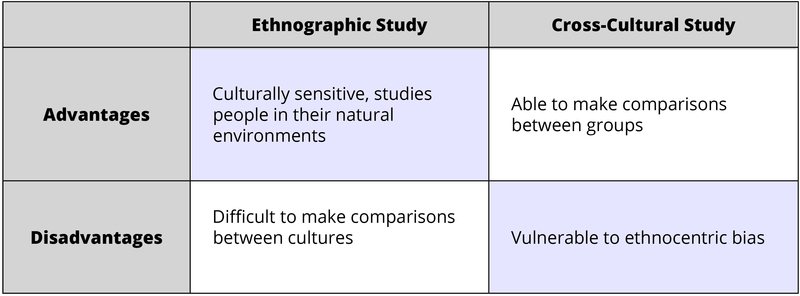
Cultural psychology is distinct from cross-cultural psychology, and this can be confusing. Cross-cultural studies are those that use standard forms of measurement, such as Likert scales, to compare people from different cultures and identify their differences. Both cultural and cross-cultural studies have their own advantages and disadvantages (see Table 1).
Interestingly, researchers—and the rest of us!—have as much to learn from cultural similarities as cultural differences, and both require comparisons across cultures. For example, Diener and Oishi (2000) were interested in exploring the relationship between money and happiness. They were specifically interested in cross-cultural differences in levels of life satisfaction between people from different cultures. To examine this question they used international surveys that asked all participants the exact same question, such as “All things considered, how satisfied are you with your life as a whole these days?” and used a standard scale for answers; in this case one that asked people to use a 1-10 scale to respond. They also collected data on average income levels in each nation, and adjusted these for local differences in how many goods and services that money can buy.
The Diener research team discovered that, across more than 40 nations there was a tendency for money to be associated with higher life satisfaction. People from richer countries such as Denmark, Switzerland and Canada had relatively high satisfaction while their counterparts from poorer countries such as India and Belarus had lower levels. There were some interesting exceptions, however. People from Japan—a wealthy nation—reported lower satisfaction than did their peers in nations with similar wealth. In addition, people from Brazil—a poorer nation—had unusually high scores compared to their income counterparts.
One problem with cross-cultural studies is that they are vulnerable to ethnocentric bias. This means that the researcher who designs the study might be influenced by personal biases that could affect research outcomes—without even being aware of it. For example, a study on happiness across cultures might investigate the ways that personal freedom is associated with feeling a sense of purpose in life. The researcher might assume that when people are free to choose their own work and leisure, they are more likely to pick options they care deeply about. Unfortunately, this researcher might overlook the fact that in much of the world it is considered important to sacrifice some personal freedom in order to fulfill one’s duty to the group (Triandis, 1995). Because of the danger of this type of bias, social psychologists must continue to improve their methodology.
What is Culture?
Defining Culture
Like the words “happiness” and “intelligence,” the word “culture” can be tricky to define. Culture is a word that suggests social patterns of shared meaning. In essence, it is a collective understanding of the way the world works, shared by members of a group and passed down from one generation to the next. For example, members of the Yanomamö tribe, in South America, share a cultural understanding of the world that includes the idea that there are four parallel levels to reality that include an abandoned level, and earthly level and heavenly and hell-like levels. Similarly, members of surfing culture understand their athletic pastime as being worthwhile and governed by formal rules of etiquette known only to insiders. There are several features of culture that are central to understanding the uniqueness and diversity of the human mind:
- Versatility: Culture can change and adapt. Someone from the state of Odisha, in India, for example, may have multiple identities. She might see herself as Odia when at home and speaking her native language. At other times, such as during the national cricket match against Pakistan, she might consider herself Indian. This is known as situational identity.
- Sharing: Culture is the product of people sharing with one another. Humans cooperate and share knowledge and skills with other members of their networks. The ways they share, and the content of what they share, helps make up culture. Older adults, for instance, remember a time when long-distance friendships were maintained through letters that arrived in the mail every few months. Contemporary youth culture accomplishes the same goal through the use of instant text messages on smart phones.
- Accumulation: Cultural knowledge is cumulative. That is, information is “stored.” This means that a culture’s collective learning grows across generations. We understand more about the world today than we did 200 years ago, but that doesn’t mean the culture from long ago has been erased by the new. For instance, members of the Haida culture—a First Nations people in British Columbia, Canada—profit from both ancient and modern experiences. They might employ traditional fishing practices and wisdom stories while also using modern technologies and services.
- Patterns: There are systematic and predictable ways of behavior or thinking across members of a culture. Patterns emerge from adapting, sharing, and storing cultural information. Patterns can be both similar and different across cultures. For example, in both Canada and India it is considered polite to bring a small gift to a host’s home. In Canada, it is more common to bring a bottle of wine and for the gift to be opened right away. In India, by contrast, it is more common to bring sweets, and often the gift is set aside to be opened later.
Understanding the changing nature of culture is the first step toward appreciating how it helps people. The concept of cultural intelligence is the ability to understand why members of other cultures act in the ways they do. Rather than dismissing foreign behaviors as weird, inferior, or immoral, people high in cultural intelligence can appreciate differences even if they do not necessarily share another culture’s views or adopt its ways of doing things.
Thinking about Culture
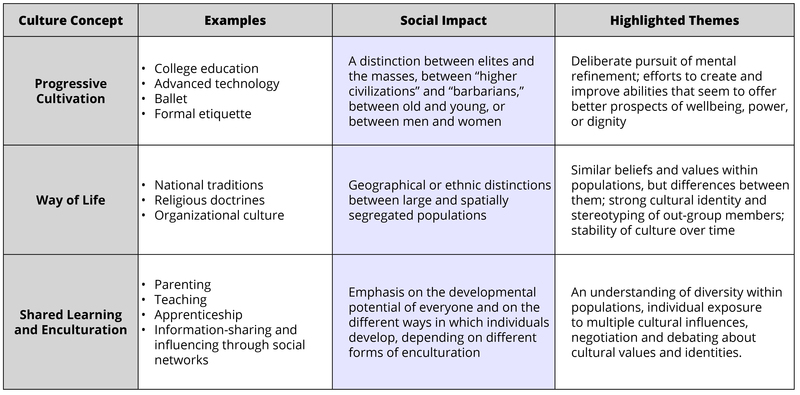
One of the biggest problems with understanding culture is that the word itself is used in different ways by different people. When someone says, “My company has a competitive culture,” does it mean the same thing as when another person says, “I’m taking my children to the museum so they can get some culture”? The truth is, there are many ways to think about culture. Here are three ways to parse this concept:
- Progressive cultivation: This refers to a relatively small subset of activities that are intentional and aimed at “being refined.” Examples include learning to play a musical instrument, appreciating visual art, and attending theater performances, as well as other instances of so-called “high art.” This was the predominant use of the word culture through the mid-19th century. This notion of culture formed the basis, in part, of a superior mindset on the behalf of people from the upper economic classes. For instance, many tribal groups were seen as lacking cultural sophistication under this definition. In the late 19th century, as global travel began to rise, this understanding of culture was largely replaced with an understanding of it as a way of life.
- Ways of Life: This refers to distinct patterns of beliefs and behaviors widely shared among members of a culture. The “ways of life” understanding of culture shifts the emphasis to patterns of belief and behavior that persist over many generations. Although cultures can be small—such as “school culture”—they usually describe larger populations, such as nations. People occasionally confuse national identity with culture. There are similarities in culture between Japan, China, and Korea, for example, even though politically they are very different. Indeed, each of these nations also contains a great deal of cultural variation within themselves.
- Shared Learning: In the 20th century, anthropologists and social psychologists developed the concept of enculturation to refer to the ways people learn about and shared cultural knowledge. Where “ways of life” is treated as a noun “enculturation” is a verb. That is, enculturation is a fluid and dynamic process. That is, it emphasizes that culture is a process that can be learned. As children are raised in a society, they are taught how to behave according to regional cultural norms. As immigrants settle in a new country, they learn a new set of rules for behaving and interacting. In this way, it is possible for a person to have multiple cultural scripts.
The understanding of culture as a learned pattern of views and behaviors is interesting for several reasons. First, it highlights the ways groups can come into conflict with one another. Members of different cultures simply learn different ways of behaving. Modern youth culture, for instance, interacts with technologies such as smart phones using a different set of rules than people who are in their 40s, 50s, or 60s. Older adults might find texting in the middle of a face-to-face conversation rude while younger people often do not. These differences can sometimes become politicized and a source of tension between groups. One example of this is Muslim women who wear a hijab, or head scarf. Non-Muslims do not follow this practice, so occasional misunderstandings arise about the appropriateness of the tradition. Second, understanding that culture is learned is important because it means that people can adopt an appreciation of patterns of behavior that are different than their own. For example, non-Muslims might find it helpful to learn about the hijab. Where did this tradition come from? What does it mean and what are various Muslim opinions about wearing one? Finally, understanding that culture is learned can be helpful in developing self-awareness. For instance, people from the United States might not even be aware of the fact that their attitudes about public nudity are influenced by their cultural learning. While women often go topless on beaches in Europe and women living a traditional tribal existence in places like the South Pacific also go topless, it is illegal for women in some of the United States to do so. These cultural norms for modesty—reflected in government laws and policies– also enter the discourse on social issues such as the appropriateness of breast-feeding in public. Understanding that your preferences are—in many cases—the products of cultural learning might empower you to revise them if doing so will lead to a better life for you or others.
The Self and Culture

Traditionally, social psychologists have thought about how patterns of behavior have an overarching effect on populations’ attitudes. Harry Triandis, a cross-cultural psychologist, has studied culture in terms of individualism and collectivism. Triandis became interested in culture because of his unique upbringing. Born in Greece, he was raised under both the German and Italian occupations during World War II. The Italian soldiers broadcast classical music in the town square and built a swimming pool for the townspeople. Interacting with these foreigners—even though they were an occupying army—sparked Triandis’ curiosity about other cultures. He realized that he would have to learn English if he wanted to pursue academic study outside of Greece and so he practiced with the only local who knew the language: a mentally ill 70 year old who was incarcerated for life at the local hospital. He went on to spend decades studying the ways people in different cultures define themselves (Triandis, 2008).
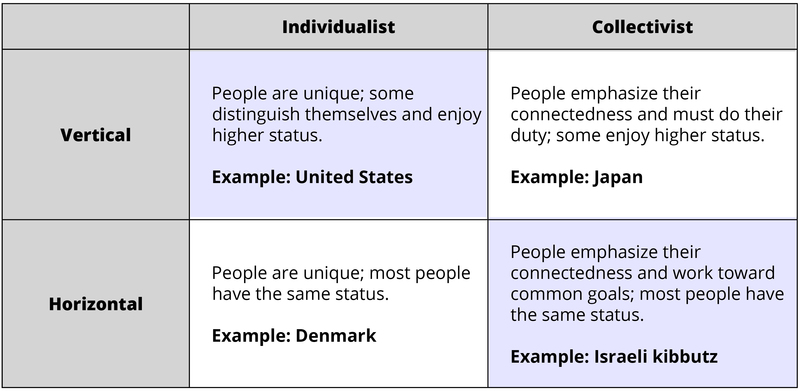
So, what exactly were these two patterns of culture Triandis focused on: individualism and collectivism? Individualists, such as most people born and raised in Australia or the United States, define themselves as individuals. They seek personal freedom and prefer to voice their own opinions and make their own decisions. By contrast, collectivists—such as most people born and raised in Korea or in Taiwan— are more likely to emphasize their connectedness to others. They are more likely to sacrifice their personal preferences if those preferences come in conflict with the preferences of the larger group (Triandis, 1995).
Both individualism and collectivism can further be divided into vertical and horizontal dimensions (Triandis, 1995). Essentially, these dimensions describe social status among members of a society. People in vertical societies differ in status, with some people being more highly respected or having more privileges, while in horizontal societies people are relatively equal in status and privileges. These dimensions are, of course, simplifications.
Neither individualism nor collectivism is the “correct way to live.” Rather, they are two separate patterns with slightly different emphases. People from individualistic societies often have more social freedoms, while collectivistic societies often have better social safety nets.
There are yet other ways of thinking about culture, as well. The cultural patterns of individualism and collectivism are linked to an important psychological phenomenon: the way that people understand themselves. Known as self-construal, this is the way people define the way they “fit” in relation to others. Individualists are more likely to define themselves in terms of an independent self. This means that people see themselves as A) being a unique individual with a stable collection of personal traits, and B) that these traits drive behavior. By contrast, people from collectivist cultures are more likely to identify with the interdependent self. This means that people see themselves as A) defined differently in each new social context and B) social context, rather than internal traits, are the primary drivers of behavior (Markus & Kitiyama, 1991).
What do the independent and interdependent self look like in daily life? One simple example can be seen in the way that people describe themselves. Imagine you had to complete the sentence starting with “I am…..”. And imagine that you had to do this 10 times. People with an independent sense of self are more likely to describe themselves in terms of traits such as “I am honest,” “I am intelligent,” or “I am talkative.” On the other hand, people with a more interdependent sense of self are more likely to describe themselves in terms of their relation to others such as “I am a sister,” “I am a good friend,” or “I am a leader on my team” (Markus, 1977).
The psychological consequences of having an independent or interdependent self can also appear in more surprising ways. Take, for example, the emotion of anger. In Western cultures, where people are more likely to have an independent self, anger arises when people’s personal wants, needs, or values are attacked or frustrated (Markus & Kitiyama, 1994). Angry Westerners sometimes complain that they have been “treated unfairly.” Simply put, anger—in the Western sense—is the result of violations of the self. By contrast, people from interdependent self cultures, such as Japan, are likely to experience anger somewhat differently. They are more likely to feel that anger is unpleasant not because of some personal insult but because anger represents a lack of harmony between people. In this instance, anger is particularly unpleasant when it interferes with close relationships.
Culture is Learned
It’s important to understand that culture is learned. People aren’t born using chopsticks or being good at soccer simply because they have a genetic predisposition for it. They learn to excel at these activities because they are born in countries like Argentina, where playing soccer is an important part of daily life, or in countries like Taiwan, where chopsticks are the primary eating utensils. So, how are such cultural behaviors learned? It turns out that cultural skills and knowledge are learned in much the same way a person might learn to do algebra or knit. They are acquired through a combination of explicit teaching and implicit learning—by observing and copying.
Cultural teaching can take many forms. It begins with parents and caregivers, because they are the primary influence on young children. Caregivers teach kids, both directly and by example, about how to behave and how the world works. They encourage children to be polite, reminding them, for instance, to say “Thankyou.” They teach kids how to dress in a way that is appropriate for the culture. They introduce children to religious beliefs and the rituals that go with them. They even teach children how to think and feel! Adult men, for example, often exhibit a certain set of emotional expressions—such as being tough and not crying—that provides a model of masculinity for their children. This is why we see different ways of expressing the same emotions in different parts of the world.

In some societies, it is considered appropriate to conceal anger. Instead of expressing their feelings outright, people purse their lips, furrow their brows, and say little. In other cultures, however, it is appropriate to express anger. In these places, people are more likely to bare their teeth, furrow their brows, point or gesture, and yell (Matsumoto, Yoo, & Chung, 2010). Such patterns of behavior are learned. Often, adults are not even aware that they are, in essence, teaching psychology—because the lessons are happening through observational learning.
Let’s consider a single example of a way you behave that is learned, which might surprise you. All people gesture when they speak. We use our hands in fluid or choppy motions—to point things out, or to pantomime actions in stories. Consider how you might throw your hands up and exclaim, “I have no idea!” or how you might motion to a friend that it’s time to go. Even people who are born blind use hand gestures when they speak, so to some degree this is a universal behavior, meaning all people naturally do it. However, social researchers have discovered that culture influences how a person gestures. Italians, for example, live in a society full of gestures. In fact, they use about 250 of them (Poggi, 2002)! Some are easy to understand, such as a hand against the belly, indicating hunger. Others, however, are more difficult. For example, pinching the thumb and index finger together and drawing a line backwards at face level means “perfect,” while knocking a fist on the side of one’s head means “stubborn.”
Beyond observational learning, cultures also use rituals to teach people what is important. For example, young people who are interested in becoming Buddhist monks often have to endure rituals that help them shed feelings of specialness or superiority—feelings that run counter to Buddhist doctrine. To do this, they might be required to wash their teacher’s feet, scrub toilets, or perform other menial tasks. Similarly, many Jewish adolescents go through the process of bar and bat mitzvah. This is a ceremonial reading from scripture that requires the study of Hebrew and, when completed, signals that the youth is ready for full participation in public worship.
Cultural Relativism
When social psychologists research culture, they try to avoid making value judgments. This is known as value-free research and is considered an important approach to scientific objectivity. But, while such objectivity is the goal, it is a difficult one to achieve. With this in mind, anthropologists have tried to adopt a sense of empathy for the cultures they study. This has led to cultural relativism, the principle of regarding and valuing the practices of a culture from the point of view of that culture. It is a considerate and practical way to avoid hasty judgments. Take for example, the common practice of same-sex friends in India walking in public while holding hands: this is a common behavior and a sign of connectedness between two people. In England, by contrast, holding hands is largely limited to romantically involved couples, and often suggests a sexual relationship. These are simply two different ways of understanding the meaning of holding hands. Someone who does not take a relativistic view might be tempted to see their own understanding of this behavior as superior and, perhaps, the foreign practice as being immoral.
Despite the fact that cultural relativism promotes the appreciation for cultural differences, it can also be problematic. At its most extreme it leaves no room for criticism of other cultures, even if certain cultural practices are horrific or harmful. Many practices have drawn criticism over the years. In Madagascar, for example, the famahidana funeral tradition includes bringing bodies out from tombs once every seven years, wrapping them in cloth, and dancing with them. Some people view this practice as disrespectful to the body of a deceased person. Another example can be seen in the historical Indian practice of sati—the burning to death of widows on their deceased husband’s funeral pyre. This practice was outlawed by the British when they colonized India. Today, a debate rages about the ritual cutting of genitals of children in several Middle Eastern and African cultures. To a lesser extent, this same debate arises around the circumcision of baby boys in Western hospitals. When considering harmful cultural traditions, it can be patronizing to the point of racism to use cultural relativism as an excuse for avoiding debate. To assume that people from other cultures are neither mature enough nor responsible enough to consider criticism from the outside is demeaning.

Positive cultural relativism is the belief that the world would be a better place if everyone practiced some form of intercultural empathy and respect. This approach offers a potentially important contribution to theories of cultural progress: to better understand human behavior, people should avoid adopting extreme views that block discussions about the basic morality or usefulness of cultural practices.
Conclusion
We live in a unique moment in history. We are experiencing the rise of a global culture in which people are connected and able to exchange ideas and information better than ever before. International travel and business are on the rise. Instantaneous communication and social media are creating networks of contacts who would never otherwise have had a chance to connect. Education is expanding, music and films cross national borders, and state-of-the-art technology affects us all. In this world, an understanding of what culture is and how it happens, can set the foundation for acceptance of differences and respectful disagreements. The science of social psychology—along with the other culture-focused sciences, such as anthropology and sociology—can help produce insights into cultural processes. These insights, in turn, can be used to increase the quality of intercultural dialogue, to preserve cultural traditions, and to promote self-awareness.
Test your Understanding
Vocabulary
- Collectivism
- The cultural trend in which the primary unit of measurement is the group. Collectivists are likely to emphasize duty and obligation over personal aspirations.
- Cross-cultural psychology (or cross-cultural studies)
- An approach to researching culture that emphasizes the use of standard scales as a means of making meaningful comparisons across groups.
- Cross-cultural studies (or cross-cultural psychology)
- An approach to researching culture that emphasizes the use of standard scales as a means of making meaningful comparisons across groups.
- Cultural differences
- An approach to understanding culture primarily by paying attention to unique and distinctive features that set them apart from other cultures.
- Cultural intelligence
- The ability and willingness to apply cultural awareness to practical uses.
- Cultural psychology
- An approach to researching culture that emphasizes the use of interviews and observation as a means of understanding culture from its own point of view.
- Cultural relativism
- The principled objection to passing overly culture-bound (i.e., “ethnocentric”) judgements on aspects of other cultures.
- Cultural script
- Learned guides for how to behave appropriately in a given social situation. These reflect cultural norms and widely accepted values.
- Cultural similarities
- An approach to understanding culture primarily by paying attention to common features that are the same as or similar to those of other cultures
- Culture
- A pattern of shared meaning and behavior among a group of people that is passed from one generation to the next.
- Enculturation
- The uniquely human form of learning that is taught by one generation to another.
- Ethnocentric bias (or ethnocentrism)
- Being unduly guided by the beliefs of the culture you’ve grown up in, especially when this results in a misunderstanding or disparagement of unfamiliar cultures.
- Ethnographic studies
- Research that emphasizes field data collection and that examines questions that attempt to understand culture from it’s own context and point of view.
- Independent self
- The tendency to define the self in terms of stable traits that guide behavior.
- Individualism
- The cultural trend in which the primary unit of measurement is the individual. Individualists are likely to emphasize uniqueness and personal aspirations over social duty.
- Interdependent self
- The tendency to define the self in terms of social contexts that guide behavior.
- Observational learning
- Learning by observing the behavior of others.
- Open ended questions
- Research questions that ask participants to answer in their own words.
- Ritual
- Rites or actions performed in a systematic or prescribed way often for an intended purpose. Example: The exchange of wedding rings during a marriage ceremony in many cultures.
- Self-construal
- The extent to which the self is defined as independent or as relating to others.
- Situational identity
- Being guided by different cultural influences in different situations, such as home versus workplace, or formal versus informal roles.
- Standard scale
- Research method in which all participants use a common scale—typically a Likert scale—to respond to questions.
- Value judgment
- An assessment—based on one’s own preferences and priorities—about the basic “goodness” or “badness” of a concept or practice.
- Value-free research
- Research that is not influenced by the researchers’ own values, morality, or opinions.
References
- Diener, E. & Oishi, S. (2000). Money and happiness: Income and subjective well-being across nations. In E. Diener & E.M. Suh (Eds), Culture and subjective well-being, Cambrdige, MA: MIT Press.
- Markus, H. (1977). Self-schemata and processing information about the self. Journal of Personality and Social Psychology, 35, 63-78.
- Markus, H. & Kitiyama, S (1994).The cultural construction of self and emotion: Implications for social behavior. In S. Kitiyama & H. Markus (Eds), Emotion and Culture: Empirical studies of mutual influence. Washington, DC: American Psychological Association.
- Markus, H. & Kitiyama, S (1991). Culture and the self: Implications for cognition, emotion and motivation. Psychological Review, 98, 224-253.
- Markus, H., Ryff, C., Curhan, K. & Palmersheim, K. (2004). In their own words: Well-being at midlife among high school and college educated adults. In O.G. Brim & C. Ryff (Eds), How healthy are we? A national study of well-being at midlife. Chicago: University of Chicago Press.
- Matsumoto, D., Yoo, S. H., & Chung, J. (2010). The expression of anger across cultures. In M. Potegal, G. Stemmler, G., and C. Spielberger (Eds.) International handbook of anger (pp.125-137). New York, NY: Springer
- Poggi, I. (2002). Towards the alphabet and the lexicon of gesture, gaze and touch. In Virtual Symposium on Multimodality of Human Communication. Retrieved from http://www.semioticon.com/virtuals/multimodality/geyboui41.pdf
- Triandis, H. C. (2008). An autobiography: Why did culture shape my career. R. Levine, A. Rodrigues & L. Zelezny, L. (Eds.). Journeys in social psychology: Looking back to inspire the future. (pp.145-164). New York, NY: Taylor And Francis.
- Triandis, H. C. (1995). Individualism and collectivism. Boulder, CO: Westview press.
Research that emphasizes field data collection and that examines questions that attempt to understand culture from it's own context and point of view.
An approach to researching culture that emphasizes the use of interviews and observation as a means of understanding culture from its own point of view.
Research questions that ask participants to answer in their own words.
An approach to researching culture that emphasizes the use of standard scales as a means of making meaningful comparisons across groups.
An approach to researching culture that emphasizes the use of standard scales as a means of making meaningful comparisons across groups.
An approach to understanding culture primarily by paying attention to common features that are the same as or similar to those of other cultures.
An approach to understanding culture primarily by paying attention to unique and distinctive features that set them apart from other cultures.
Research method in which all participants use a common scale—typically a Likert scale—to respond to questions.
Being unduly guided by the beliefs of the culture you’ve grown up in, especially when this results in a misunderstanding or disparagement of unfamiliar cultures.
A pattern of shared meaning and behavior among a group of people that is passed from one generation to the next.
Being guided by different cultural influences in different situations, such as home versus workplace, or formal versus informal roles.
The ability and willingness to apply cultural awareness to practical uses.
The uniquely human form of learning that is taught by one generation to another.
Learned guides for how to behave appropriately in a given social situation. These reflect cultural norms and widely accepted values.
The cultural trend in which the primary unit of measurement is the individual. Individualists are likely to emphasize uniqueness and personal aspirations over social duty.
The cultural trend in which the primary unit of measurement is the group. Collectivists are likely to emphasize duty and obligation over personal aspirations.
The extent to which the self is defined as independent or as relating to others.
The tendency to define the self in terms of stable traits that guide behavior.
The tendency to define the self in terms of social contexts that guide behavior.
Learning by observing the behavior of others
Rites or actions performed in a systematic or prescribed way often for an intended purpose. Example: The exchange of wedding rings during a marriage ceremony in many cultures.
An assessment—based on one’s own preferences and priorities—about the basic “goodness” or “badness” of a concept or practice.
Research that is not influenced by the researchers’ own values, morality, or opinions.
The principled objection to passing overly culture-bound (i.e., “ethnocentric”) judgements on aspects of other cultures.