
5: Liking and Loving
5.1 Initial Attraction
Learning Objectives
- Summarize the variables that lead to initial attraction between people.
- Outline the variables that lead us to perceive someone as physically attractive, and explain why physical attractiveness is so important in liking.
- Describe the ways that similarity and complementarity influence our liking for others.
- Define the concept of mere exposure, and explain how proximity influences liking.
- Explore the relationship between affect and attraction.
When we say that we like or love someone, we are experiencing interpersonal attraction—the strength of our liking or loving for another person. Although interpersonal attraction occurs between friends, family members, and other people in general, and although our analysis can apply to these relationships as well, our primary focus in this chapter will be on romantic attraction, whether in opposite-sex or same-sex relationships. There is a large literature on the variables that lead us to like others in our initial interactions with them, and we’ll review the most important findings here (Sprecher, Wenzel, & Harvey, 2008).
Physical Attractiveness
Although it may seem inappropriate or shallow to admit it, and although it is certainly not the only determinant of liking, people are strongly influenced, at least in initial encounters, by the physical attractiveness of their partners (Swami & Furnham, 2008). Elaine Walster and her colleagues (Walster, Aronson, Abrahams, & Rottman, 1966) arranged a field study in which college boys and girls were randomly paired with one another at a “computer dance.” After the partners had danced and talked for a couple of hours, they were interviewed separately about their own preferences and characteristics as well as about their perceptions of their date. Walster and her colleagues found that the only important determinant of participants’ liking for their date was his or her physical attractiveness. None of the other characteristics—even the perceived intelligence of the partner—mattered.
Perhaps this finding doesn’t surprise you too much, given the importance of physical attractiveness in popular culture. Movies and TV shows often feature unusually attractive people, TV ads use attractive people to promote their products, and many people spend considerable amounts of money each year to make themselves look more attractive. Even infants who are only a year old prefer to look at faces that adults consider attractive rather than at unattractive faces (Langlois, Ritter, Roggman, & Vaughn, 1991).
People who are attractive are also seen as having a variety of positive characteristics, and these traits are activated quickly and spontaneously when we see their faces (Olson & Marshuetz, 2005; van Leeuwen & Macrae, 2004). For instance, more attractive people are seen as more sociable, altruistic, and intelligent than their less attractive counterparts (Griffin & Langlois, 2006). Similar patterns have been found in relation to online contexts. For example, those judged more attractive on the basis of their online dating site photographs are also rated as having more positive profiles in terms of text content (Brand, Bonatsos, D’Orazio, & DeShong, 2012).
Attractive people also have more choices of sex partners (Epstein, Klinkenberg, Scandell, Faulkner, & Claus, 2007), are more likely to be offered jobs (Dubois & Pansu, 2004), and may even live longer (Henderson & Anglin, 2003). These positive evaluations of and behavior toward attractive people likely relate to the belief that external attractiveness signifies positive internal qualities, which has been referred to as the what is beautiful is good stereotype (Dion, Berscheid, & Walster, 1972).
Although it is sometimes said that “beauty is in the eyes of the beholder” (i.e., that each person has his or her own idea about what is beautiful), this is not completely true. There is good agreement among people, including children, and within and across cultures, about which people are most physically attractive (Berry, 2000; Ramsey, Langlois, Hoss, Rubenstein, & Griffin, 2004). This agreement is in part due to shared norms within cultures about what is attractive, which may of course vary among cultures, but it is also due to evolutionary predispositions to attend to and be influenced by specific characteristics of others.
Leslie Zebrowitz and her colleagues have extensively studied the tendency for both men and women to prefer facial features that have youthful characteristics (Zebrowitz, 1996). These features include large, round, and widely spaced eyes, a small nose and chin, prominent cheekbones, and a large forehead. Zebrowitz has found that individuals who have youthful-looking faces are more liked, are judged as warmer and more honest, and also receive other positive outcomes. Parents give baby-faced children fewer chores and punishments, and people with young-looking faces are also required to pay lower monetary awards in courtroom trials (Zebrowitz & McDonald, 1991). On the other hand, baby-faced individuals are also seen as less competent than their more mature-looking counterparts (Zebrowitz & Montpare, 2005).

The preference for youth is found in our perceptions of both men and women but is somewhat stronger for our perceptions of women (Wade, 2000). This is because for men, although we do tend to prefer youthful faces, we also prefer stereotypically masculine faces—those with low, broad jaws and with pronounced bone ridges and cheekbones—and these men tend to look somewhat older (Rhodes, 2006). We may like baby-faced people because they remind us of babies, or perhaps because we respond to baby-faced people positively, they may act more positively to us.
Some faces are more symmetrical than others. People are more attracted to faces that are more symmetrical in comparison with those that are less symmetrical. This may be in part because of the perception that people with symmetrical faces are more healthy and thus make better reproductive mates (Rhodes, 2006; Rhodes et al., 2001) and in part because symmetrical faces seem more familiar and thus less threatening to us (Winkielman & Cacioppo, 2001). The attraction to symmetry is not limited to face perception. Body symmetry is also a likely indicator of good genes, and women favor more symmetrical men as sexual partners (Gangestad & Thornhill, 1997). Symmeter provides software to check if your own face is perfectly symmetrical.

Although you might think that we would prefer faces that are unusual or unique, in fact the opposite is true (Langlois, Roggman, & Musselman, 1994). Langlois and Roggman (1990) showed college students the faces of men and women. The faces were composites made up of the average of 2, 4, 8, 16, or 32 faces. The researchers found that the more faces that were averaged into the stimulus, the more attractive it was judged (Figure 5.4, “Facial Averageness”). As with the findings for facial symmetry, one possible explanation for our liking of average faces is that because they are more similar to the ones that we have frequently seen, they are thus more familiar to us (Grammer, Fink, Juette, Ronzal, & Thornhill, 2002).
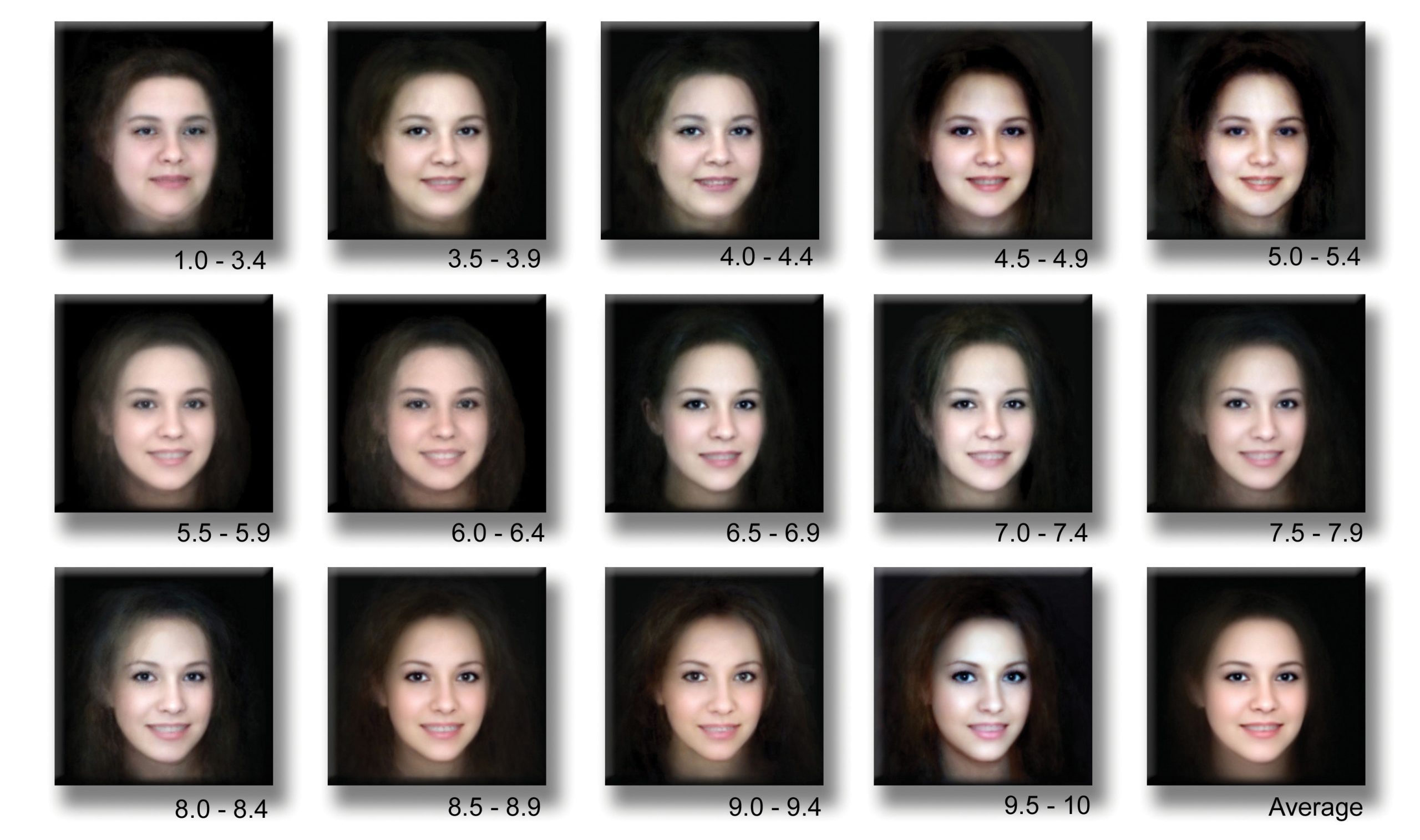
Other determinants of perceived attractiveness are healthy skin, good teeth, a smiling expression, and good grooming (Jones, Pelham, Carvall, & Mirenberg, 2004; Rhodes, 2006; Willis, Esqueda, & Schacht, 2008). These features may also have evolutionary significance—people with these characteristics probably appear to be healthy.
Although the preferences for youth, symmetry, and averageness appear to be universal, at least some differences in perceived attractiveness are due to social factors. What is seen as attractive in one culture may not be seen as attractive in another, and what is attractive in a culture at one time may not be attractive at another time. To consider one example, in modern Western cultures, people prefer those who have little excess fat and who look physically fit (Crandall, Merman, & Hebl, 2009; Hönekopp, Rudolph, Beier, Liebert, & Müller, 2007; Weeden & Sabini, 2005).
However, the norm of thinness has not always been in place. The preference for women with slender, masculine, and athletic looks has become stronger over the past 50 years in Western cultures, and this can be seen by comparing the figures of female movie stars from the 1940s and 1950s with those of today. In contrast to the relatively universal preferences for youth, symmetry, and averageness, other cultures do not show such a strong propensity for thinness (Anderson, Crawford, Nadeau, & Lindberg, 1992). In cultures where food is more scarce, for example, being heavier as opposed to thinner is more associated with perceived attractiveness (Nelson & Morrison, 2005).
Gender Differences in Perceived Attractiveness
You might wonder whether men and women find different mates attractive. The answer is yes, although as in most cases with gender differences, the differences are outweighed by overall similarities. Overall, both men and women value physical attractiveness, as well as certain personality characteristics, such as kindness, humor, dependability, intelligence, and sociability; this is true across many different cultures (Berry, 2000; Li, Bailey, Kenrick, & Linsenmeier, 2002). For men, however, the physical attractiveness of women is most important; women, although also interested in the attractiveness of men, are relatively more interested in the social status of a potential partner. When they are forced to choose one or the other, women from many different cultures have been found to more often prioritize a man’s status over his physical attractiveness, whereas men tend to prioritize a woman’s attractiveness over her status (Li, Bailey, Kenrick, & Linsenmeier, 2002).
The differences between the preferences of men and women for opposite-sex romantic partners have been demonstrated in archival research that has analyzed the ads placed in the classifieds of newspapers and online profiles. The personal ads that men place when they are searching for women tend to focus on the preferred physical appearance of the desired partner. Personal ads placed by women seeking men, on the other hand, are more likely to specify the preferred partner’s status and material resources (Harrison & Saeed, 1977; Wiederman, 1993). Furthermore, women actually respond more to men who advertise their (high) income and educational levels, whereas men are less interested in this information in women’s ads (Baize & Schroeder, 1995). These findings seem to be due to universal preferences of men and women, because similar patterns have been found across cultures, and also in ads seeking same-sex partners (Buss, 1989).
Age also matters, such that the preference for youthful partners is more important for men than for women. Women have been found to be more likely to respond to personal ads placed by relatively older men, whereas men tend to respond to ads placed by younger women—men of all ages (even teenagers) are most attracted to women who are in their 20s. Younger people (and particularly younger women) are more fertile than older people, and research suggests that men may thus be evolutionarily predisposed to like them more (Buunk, Dijkstra, Kenrick, & Warntjes, 2001; Dunn, Brinton, & Clark, 2010; Kenrick & Li, 2000).
Another research finding consistent with the idea that men are looking for cues to fertility in their partners is that across many cultures, men have a preference for women with a low waist-to-hip ratio (i.e., large hips and a small waist), a shape that is likely to indicate fertility. On the other hand, women prefer men with a more masculine-appearing waist-to-hip ratio (similar waist and hip size; Singh, 1995; Swami, 2006). Recent research, however, has suggested that these preferences, too, may be in part due to a preference for averageness, rather than to a specific preference for a particular waist-to-hip ratio (Donohoe, von Hippel, & Brooks, 2009).
Men across a wide range of cultures are more willing, on average, to have casual sex than are women, and their standards for sex partners tend to be lower (Petersen & Hyde, 2010; Saad, Eba, & Sejan, 2009). And when asked about their regrets in life, men are more likely to wish they had had sex with more partners, whereas women more often than men wished they had tried harder to avoid getting involved with men who did not stay with them (Roese et al., 2006). These differences may be influenced by differential evolutionary-based predispositions of men and women. Evolutionary arguments suggest that women should be more selective than men in their choices of sex partners because they must invest more time in bearing and nurturing their children than do men (most men do help out, of course, but women simply do more; Buss & Kenrick, 1998). Because they do not need to invest a lot of time in child rearing, men may be evolutionarily predisposed to be more willing and desiring of having sex with many different partners and may be less selective in their choice of mates. Women on the other hand, because they must invest substantial effort in raising each child, tend to be more selective.
But gender differences in mate preferences may also be accounted for in terms of social norms and expectations. Overall, on average, across the world as a whole, women still tend to have lower status than men, and as a result, they may find it important to attempt to raise their status by marrying men who have more of it. Men who, on average, already have higher status may be less concerned in this regard, allowing them to focus relatively more on physical attractiveness. Consistent with these arguments, some studies show that women’s preference for men of high status, rather than for physically attractive men, is greatest in cultures in which women are less well educated, poorer, and have less control over conception and family size (Petersen & Hyde, 2010).
Why Is Physical Attractiveness So Important?
You might find yourself wondering why people find physical attractiveness so important when it seems to say so little about what the person is really like as a person. If beauty is really only “skin deep,” as the proverb goes, why are we so concerned with it?
One reason that we like attractive people is because they are rewarding. We like being around attractive people because they are enjoyable to look at and because being with them makes us feel good about ourselves. Attractiveness can imply high status, and we naturally like being around people who have it. Furthermore, the positive features of attractive people tend to “rub off” on those around them as a result of associational learning (Sigall & Landy, 1973).
As we touched on earlier in our discussion of the what is beautiful is good heuristic, we may also like attractive people because they are seen as better friends and partners. Physically more attractive people are seen as more dominant, sexually warm, mentally healthy, intelligent, and socially skilled than are physically less attractive people (Eagly, Ashmore, Makhijani, & Longo, 1991). These assumptions about the internal qualities of attractive people also show some cross-cultural consistency. For example, individuals from Eastern and Western cultures tend to agree that attractiveness signifies qualities like sociability and popularity. On the other hand, there is some evidence that those from collectivistic cultures, which stress interdependence, tend to equate attractiveness with traits related to concern for others than those from more independently oriented, individualistic cultures (Wheeler & Kim, 1997). The opposite was found in regards to traits stressing independence.
One outcome of favorable evaluations of and behaviors toward attractive people is that they receive many social benefits from others. Attractive people are given better grades on essay exams, are more successful on job interviews, and receive lighter sentences in court judgments in comparison with their less attractive counterparts (Hosoda, Stone-Romero, & Coats, 2003). We are all of course aware of the physical attractiveness stereotype and make use of it when we can. We try to look our best on dates, at job interviews, and (not necessary, we hope!) for court appearances.
As with many stereotypes, there may be some truth to the what is beautiful is good stereotype. Research has found at least some evidence for the idea that attractive people are actually more sociable, more popular, and less lonely compared with less attractive individuals (Diener, Wolsic, & Fujita, 1995). These results are probably partly the result of self-fulfilling prophecies. Because people expect attractive others to be friendly and warm, and because they want to be around them, they treat attractive people more positively than they do unattractive people. In the end, this may lead attractive people to develop these positive characteristics (Zebrowitz, Andreoletti, Collins, Lee, & Blumenthal, 1998). However, as with most stereotypes, our expectations about the different characteristics of attractive and unattractive individuals are much stronger than the real differences between them.
Similarity: We Like Those Who Are Like Us
Although it is a very important variable, finding someone physically attractive is of course often only the first stage in developing a close relationship with another person. If we find someone attractive, we may want to pursue the relationship. And if we are lucky, that person will also find us attractive and be interested in the possibility of developing a closer relationship. At this point, we will begin to communicate, sharing our values, beliefs, and interests, and begin to determine whether we are compatible in a way that leads to increased liking.
Relationships are more likely to develop and be maintained to the extent that the partners share external, demographic characteristics, and internal ones like values and beliefs. Research across many cultures has found that people tend to like and associate with others who share their age, education, race, religion, level of intelligence, and socioeconomic status (Watson et al., 2004). It has even been found that taller people tend to like other tall people, that happy people tend to like other happy people, and that people particularly enjoy being with others who have the same birthday and a similar sense of humor (Jones, Pelham, Carvallo, & Mirenberg, 2004; Pinel, Long, Landau, Alexander, & Pyszczynski, 2006). One classic study (Newcomb, 1961) arranged for male undergraduates, all strangers, to live together in a house while they were going to school. The men whose attitudes were similar during the first week ended up being friends, whereas those who did not initially share attitudes were significantly less likely to become friends.
Why Does Similarity Matter?
Similarity leads to attraction for a variety of reasons. For one, similarity makes things easier. You can imagine that if you only liked to go to action movies but your partner only liked to go to foreign films, this would create difficulties in choosing an evening activity. Things would be even more problematic if the dissimilarity involved something even more important, such as your attitudes toward the relationship itself. Perhaps you want to have sex but your partner doesn’t, or perhaps your partner wants to get married but you don’t. These dissimilarities are going to create real problems. Romantic relationships in which the partners hold different religious and political orientations or different attitudes toward important issues such as premarital sex, marriage, and child rearing are of course not impossible—but they are more complicated and take more effort to maintain.
In addition to being easier, relationships with those who are similar to us are also reinforcing. Imagine you are going to a movie with your very best friend. The movie begins, and you realize that you are starting to like it a lot. At this point, you might look over at your friend and wonder how she is reacting to it. One of the great benefits of sharing beliefs and values with others is that those others tend to react the same way to events as you do. Wouldn’t it be painful if every time you liked a movie, your best friend hated it, and every time your friend liked it, you hated it? But you probably don’t need to worry too much about this, because your friend is probably your friend in good part because he or she likes the same things you like. Odds are that if you like the movie, your friend will too, and because he or she does, you can feel good about yourself and about your opinions of what makes a good movie. Sharing our values with others and having others share their values with us help us validate the worthiness of our self-concepts. Finding similarities with another makes us feel good and makes us feel that the other person will reciprocate our liking for them (Singh, Yeo, Lin, & Tan, 2007).
Status Similarity
Many people want to have friends and form relationships with people who have high status. They prefer to be with people who are healthy, attractive, wealthy, fun, and friendly. But their ability to attract such high-status partners is limited by the principles of social exchange. It is no accident that attractive people are more able to get dates with other attractive people, for example. The basic principles of social exchange and equity dictate that there will be general similarity in status among people in close relationships because attractiveness is a resource that allows people to attract other people with resources (Kalick & Hamilton, 1986; Lee, Loewenstein, Ariely, Hong, & Young, 2008). Of course, there are exceptions to every rule, and although it seems surprising to us when one partner appears much more attractive than the other, we may well assume that the less attractive partner is offering some type of (perhaps less visible) social status in return.
There is still one other type of similarity that is important in determining whether a relationship will grow and continue, and it is also based on the principles of social exchange and equity. The finding is rather simple—we tend to prefer people who seem to like us about as much as we like them. Imagine, for instance, that you have met someone and you are hoping to pursue a relationship with that person. You begin to give yourself to the relationship by opening up to the other person, telling him or her about yourself and making it clear that you would like to pursue a closer relationship. You make yourself available to spend time with the person and contact him or her regularly. You hope that he or she feels the same amount of liking, and that you will receive the same type of behaviors in return. If the person does not return the openness and giving, the relationship is not going to go very far.
Relationships in which one person likes the other much more than the other likes him or her can be inherently unstable because they are not balanced or equitable. An unfortunate example of such an imbalanced relationship occurs when one individual continually attempts to contact and pursue a relationship with another person who is not interested in one. It is difficult for the suitor to give up the pursuit because he or she feels passionately in love with the other, and his or her self-esteem will be hurt if the other person is rejecting. But the situation is also not comfortable for the individual who is being pursued because that person feels both guilty about rejecting the suitor and angry that the suitor continues the pursuit (Baumeister & Wotman, 1992). Such situations are not uncommon and require that the individual who is being pursued make it completely clear that he or she is not interested in any further contact.
There is a clear moral to the importance of liking similarity, and it pays to remember it in everyday life. If we act toward others in a positive way, this expresses liking and respect for them, and the others will likely return the compliment. Being liked, praised, and even flattered by others is rewarding, and (unless it is too blatant and thus ingratiating, as we saw when we discussed self-presentation) we can expect that others will enjoy it.
In sum, similarity is probably the most important single determinant of liking. Although we may sometimes prefer people who have different interests and skills from ours (Beach, Whitaker, Jones, & Tesser, 2001; Tiedens & Jimenez, 2003), when it comes to personality traits, it is similarity that matters—complementarity (being different from the other) just does not generally have much influence on liking.
Proximity
If someone were to ask you who you might end up marrying (assuming you are not married already and would like to get married), they would guess that you’d respond with a list of perhaps the preferred personality traits or an image of your desired mate. You’d probably say something about being attractive, rich, creative, fun, caring, and so forth. And there is no question that such individual characteristics matter. But social psychologists realize that there are other aspects that are perhaps even more important. Consider this:
You’ll never marry someone whom you never meet!
Although that seems obvious, it’s also really important. There are about 7 billion people in the world, and you are only going to have the opportunity to meet a tiny fraction of those people before you marry. This also means that you are likely to marry someone who’s pretty similar to you because, unless you travel widely, most of the people you meet are going to share at least part of your cultural background and therefore have some of the values that you hold. In fact, the person you marry probably will live in the same city as you, attend the same school, take similar classes, work in a similar job and be similar to you in other respects (Kubitschek & Hallinan, 1998).
Although meeting someone is an essential first step, simply being around another person also increases liking. People tend to become better acquainted with, and more fond of, each other when the social situation brings them into repeated contact, which is the basic principle of proximity liking. For instance, research has found that students who sit next to each other in class are more likely to become friends, and this is true even when the seating is assigned by the instructor (Back, Schmukle, & Egloff, 2008). Festinger, Schachter, and Back (1950) studied friendship formation in people who had recently moved into a large housing complex. They found not only that people became friends with those who lived near them but that people who lived nearer the mailboxes and at the foot of the stairway in the building (where they were more likely to come into contact with others) were able to make more friends than those who lived at the ends of the corridors in the building and thus had fewer social encounters with others.
The mere exposure effect refers to the tendency to prefer stimuli (including, but not limited to, people) that we have seen frequently. Consider the research findings presented in Figure 5.5, “Mere Exposure in the Classroom.”In this study, Moreland and Beach (1992) had female confederates attend a large lecture class of over 100 students 5, 10, or 15 times or not at all during a semester. At the end of the term, the students were shown pictures of the confederates and asked to indicate if they recognized them and also how much they liked them. The number of times the confederates had attended class didn’t influence the other students’ recognition of them, but it did influence their liking for them. As predicted by the mere-exposure hypothesis, students who had attended more often were liked more.

Richard Moreland and Scott Beach had female confederates visit a class 5, 10, or 15 times or not at all over the course of a semester. Then the students rated their liking of the confederates. The mere exposure effect is clear. Data are from Moreland and Beach (1992).
The effect of mere exposure is powerful and occurs in a wide variety of situations (Bornstein, 1989). Infants tend to smile at a photograph of someone they have seen before more than they smile at someone they are seeing for the first time (Brooks-Gunn & Lewis, 1981). And people have been found to prefer left-to-right reversed images of their own face over their normal (nonreversed) face, whereas their friends prefer their regular face over the reversed one (Mita, Dermer, & Knight, 1977). This also is expected on the basis of mere exposure, since people see their own faces primarily in mirrors and thus are exposed to the reversed face more often.
Mere exposure may well have an evolutionary basis. We have an initial and potentially protective fear of the unknown, but as things become more familiar, they produce more positive feelings and seem safer (Freitas, Azizian, Travers, & Berry, 2005; Harmon-Jones & Allen, 2001). When the stimuli are people, there may well be an added effect—familiar people are more likely to be seen as part of the ingroup rather than the outgroup, and this may lead us to like them even more. Leslie Zebrowitz and her colleagues showed that we like people of our own race in part because they are perceived as familiar to us (Zebrowitz, Bronstad, & Lee, 2007).
Keep in mind that mere exposure applies only to the change that occurs when one is completely unfamiliar with another person (or object) and subsequently becomes more familiar with him or her. Thus mere exposure applies only in the early stages of attraction. Later, when we are more familiar with someone, that person may become too familiar and thus boring. You may have experienced this effect when you first bought some new songs and began to listen to them. Perhaps you didn’t really like all the songs at first, but you found yourself liking them more and more as you played them more often. If this has happened to you, you have experienced mere exposure. But perhaps one day you discovered that you were really tired of the songs—they had become too familiar. You put the songs away for a while, only bringing them out later, when you found that liked them more again (they were now less familiar). People prefer things that have an optimal level of familiarity—neither too strange nor too well known (Bornstein, 1989).
Affect and Attraction
Because our relationships with others are based in large part on emotional responses, it will come as no surprise to you to hear that affect is particularly important in interpersonal relationships. The relationship between mood and liking is pretty straightforward. We tend to like people more when we are in good moods and to like them less when we are in bad moods. This prediction follows directly from the expectation that affective states provide us with information about the social context—in this case, the people around us. Positive affect signals that it is safe and desirable to approach the other person, whereas negative affect is more likely to indicate danger and to suggest avoidance.
Moods are particularly important and informative when they are created by the person we are interacting with. When we find someone attractive, for instance, we experience positive affect, and we end up liking the person even more. However, mood that is created by causes other than the other person can also influence liking. Alice Isen and her colleagues (Isen & Levin, 1972) created a variety of situations designed to put people in good moods. They had participants unexpectedly find a coin in a phone booth, played them some soothing music, or provided them a snack of milk and cookies at an experimental session. In each of these cases, the participants who had been provided with the pleasant experience indicated more positive mood in comparison with other participants who had not received the positive experience—and they also expressed more liking for other things and other people. The moral of the story is clear—if you want to get someone to like you, put that person in a good mood. Furthermore, it is pretty easy to do so—simply bringing flowers, looking your best, or telling a funny joke might well be enough to be effective.
Research Focus
Arousal and Attraction
Although the relationship between mood and liking is very simple, the relationship between our current state of physiological arousal and liking is more complex. Consider an experiment by Gregory White and his colleagues (White, Fishbein, & Rutsein, 1981) in which the participants, male college students, were asked to complete a number of different tasks in a laboratory setting. In one part of the study, the men were asked to run in place for either a short time (15 seconds) or a longer time (120 seconds). Then the men viewed a videotape of either an attractive or an unattractive woman who was supposedly a sophomore at the college. In the video, she talked about her hobbies and career interests and indicated that she was interested in meeting people and did not have a boyfriend. The men, who thought that they would soon be meeting the woman, rated how romantically attracted they were to her.
Confirming that the experimental manipulation had created high and low levels of arousal, White and his colleagues found that the heart rate and other signs of physiological arousal were higher for the participants who had exercised longer. They did not find that the arousal created by running in place for 120 seconds increased or decreased liking directly, but they did find an interaction between arousal level and the attractiveness of the woman being judged. As you can see in the following figure, the men who had been aroused by running in place liked the attractive woman more and the unattractive woman less than the men who were less aroused.
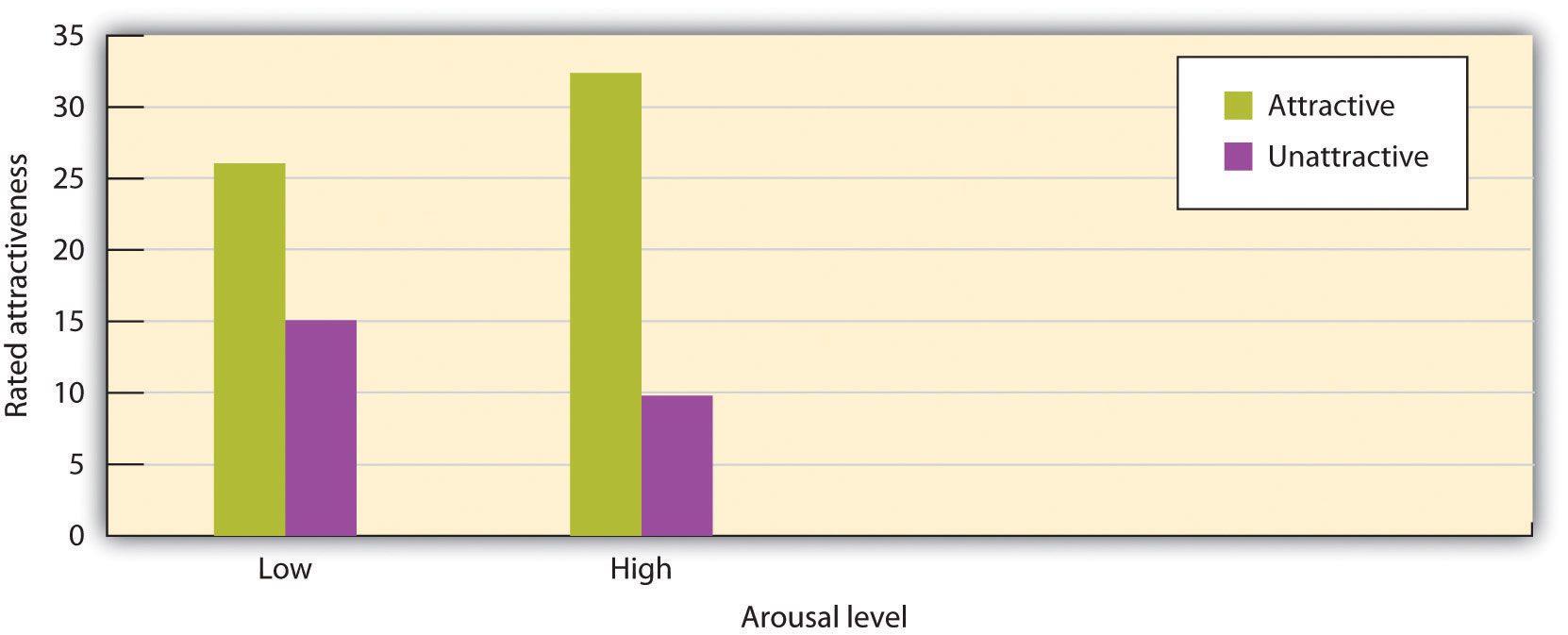
Arousal polarizes judgments. In this experiment, male college students rated an attractive or an unattractive woman after they had run in place for 15 seconds (low arousal) or for 120 seconds (high arousal). The judgments under arousal are polarized. Data are from White, Fishbein, and Rutstein (1981).
In another interesting field study, Dutton and Aron (1974) had an attractive young woman approach individual young men as they crossed a long, wobbly suspension bridge hanging over 200 feet above the Capilano River in British Columbia. The woman asked each man to help her fill out a questionnaire for a class project. When he had finished, she wrote her name and phone number on a piece of paper and invited him to call if he wanted to hear more about the project. Over half of the men who had been interviewed on the bridge later called her. In contrast, men who were approached on a low solid bridge by the same experimenter, or who were interviewed on the suspension bridge by men, called to learn about the project significantly less frequently. Echoing our discussion of social cognition and affect, one interpretation of this finding is that the men who were interviewed on the bridge were experiencing arousal as a result of being on the bridge but that they misattributed their arousal as liking for the female interviewer.

These studies and many others like them demonstrate that arousal polarizes liking (Foster, Witcher, Campbell, & Green, 1998). When we are aroused, everything seems more extreme. This effect is not unexpected because the function of arousal in emotion is to increase the strength of an emotional response. Love that is accompanied by arousal (sexual or otherwise) is stronger love than love that has a lower level of arousal. And our feelings of anger, dislike, or disgust are also stronger when they are accompanied by high arousal.
As with mood states, arousal may sometimes come directly from the partner. Both very attractive and very unattractive people are likely to be more arousing than are people who are more average in attractiveness, and this arousal may create strong feelings of like or dislike. In other cases, the arousal may come from another source, such as from exercising, walking across a high bridge, or a roller-coaster ride.
The strong feelings that we experience toward another person that are accompanied by increases in arousal and sexual attraction are called passion, and the emotionally intense love that is based on passion is known as passionate love—the kind of love that we experience when we are first getting to know a romantic partner. Again, there is a clear take-home lesson for you: If you like a person and think that the person likes you in return, and if you want to get that person to like you more, then it will be helpful to create some extra arousal in that person, perhaps by going to a scary movie, taking them up a tall building for dinner, or even meeting for a workout at the gym. On the other hand, you need to be sure that the other person is initially positively inclined toward you. If not, arousing experiences could make matters even worse!
Key Takeaways
- Particularly in initial encounters, people are strongly influenced by the physical attractiveness of the other person.
- People tend to prefer people who are young, who have symmetrical facial features and bodies, and who appear average. These preferences may be because these features suggest to us that the person is healthy.
- Although men and women agree on many aspects of what they find attractive, women are relatively more focused on the social status of their romantic partners, whereas men are more focused on the youth and attractiveness of their partners.
- We tend to like people who share our values and beliefs, both because similarity makes things easier and because similarity reinforces our own values and beliefs.
- Proximity and the principle of mere exposure are two important determinants of interpersonal attraction.
- We tend to like people more when we are in a good mood.
- Our current state of physiological arousal tends to polarize our liking.
References
Anderson, J. L., Crawford, C. B., Nadeau, J., & Lindberg, T. (1992). Was the Duchess of Windsor right? A cross-cultural review of the socioecology of ideals of female body shape. Ethology and Sociobiology, 13(3), 197–227.
Back, M. D., Schmukle, S. C., & Egloff, B. (2008). Becoming friends by chance. Psychological Science, 19(5), 439–440.
Baize, H. R., & Schroeder, J. E. (1995). Personality and mate selection in personal ads: Evolutionary preferences in a public mate selection process. Journal of Social Behavior and Personality, 10(3), 517–536.
Baumeister, R. F., & Wotman, S. R. (1992). Breaking hearts: The two sides of unrequited love. New York, NY: Guilford Press
Beach, S. R. H., Whitaker, D. J., Jones, D. J., & Tesser, A. (2001). When does performance feedback prompt complementarity in romantic relationships? Personal Relationships, 8(3), 231–248;
Berry, D. S. (2000). Attractiveness, attraction, and sexual selection: Evolutionary perspectives on the form and function of physical attractiveness. Advances in Experimental Social Psychology, 32, 273–342;
Bornstein, R. F. (1989). Exposure and affect: Overview and meta-analysis of research, 1968–1987. Psychological Bulletin, 106(2), 265–289.
Brand, R. J., Bonatsos, A., D’Orazio, R., & DeShong, H. (2012). What is beautiful is good, even online: Correlations between photo attractiveness and text attractiveness in men’s online dating profiles.Computers In Human Behavior, 28(1), 166-170. doi:10.1016/j.chb.2011.08.023
Brooks-Gunn, J., & Lewis, M. (1981). Infant social perception: Responses to pictures of parents and strangers. Developmental Psychology, 17(5), 647–649.
Buss, D. M. (1989). Sex differences in human mate preferences: Evolutionary hypotheses tested in 37 cultures. Behavioral and Brain Sciences, 12(1), 1–49.
Buss, D., & Kenrick, D. (1998). Evolutionary social psychology. In D. T. Gilbert, S. T. Fiske, & G. Lindzey (Eds.), Handbook of social psychology (4th ed., Vol. 2, pp. 982–1026). Boston, MA: McGraw-Hill.
Buunk, B. P., Dijkstra, P., Kenrick, D. T., & Warntjes, A. (2001). Age preferences for mates as related to gender, own age, and involvement level. Evolution and Human Behavior, 22(4), 241–250;
Crandall, C. S., Merman, A., & Hebl, M. (2009). Anti-fat prejudice. In T. D. Nelson (Ed.), Handbook of prejudice, stereotyping, and discrimination (pp. 469–487). New York, NY: Psychology Press;
Diener, E., Wolsic, B., & Fujita, F. (1995). Physical attractiveness and subjective well-being. Journal of Personality and Social Psychology, 69(1), 120–129;
Dion, K., Berscheid, E., & Walster, E. (1972). What is beautiful is good. Journal of Personality and Social Psychology, 24(3), 285–290.
Donohoe, M. L., von Hippel, W., & Brooks, R. C. (2009). Beyond waist-hip ratio: Experimental multivariate evidence that average women’s torsos are most attractive. Behavioral Ecology, 20(4), 716–721.
Dubois, M., & Pansu, P. (2004). Facial attractiveness, applicants’ qualifications, and judges’ expertise about decisions in preselective recruitment. Psychological Reports, 95(3, Pt. 2), 1129–1134.
Dunn, M. J., Brinton, S., & Clark, L. (2010). Universal sex differences in online advertisers age preferences: Comparing data from 14 cultures and 2 religious groups. Evolution and Human Behavior, 31(6), 383–393;
Dutton, D., & Aron, A. (1974). Some evidence for heightened sexual attraction under conditions of high anxiety. Journal of Personality and Social Psychology, 30, 510–517.
Eagly, A. H., Ashmore, R. D., Makhijani, M. G., & Longo, L. C. (1991). What is beautiful is good, but…: A meta-analytic review of research on the physical attractiveness stereotype. Psychological Bulletin, 110(1), 109–128.
Epstein, J., Klinkenberg, W. D., Scandell, D. J., Faulkner, K., & Claus, R. E. (2007). Perceived physical attactiveness, sexual history, and sexual intentions: An internet study. Sex Roles, 56(1–2), 23–31.
Festinger, L., Schachter, S., & Back, K. (1950). Social pressures in informal groups. New York, NY: Harper.
Foster, C. A., Witcher, B. S., Campbell, W. K., & Green, J. D. (1998). Arousal and attraction: Evidence for automatic and controlled processes. Journal of Personality and Social Psychology, 74(1), 86–101.
Freitas, A. L., Azizian, A., Travers, S., & Berry, S. A. (2005). The evaluative connotation of processing fluency: Inherently positive or moderated by motivational context? Journal of Experimental Social Psychology, 41(6), 636–644;
Gangestad, S. W., & Thornhill, R. (1997). The evolutionary psychology of extra-pair sex: The role of fluctuating asymmetry. Evolution and Human Behavior, 18(2), 69–88.
Grammer, K., Fink, B., Juette, A., Ronzal, G., & Thornhill, R. (2002). Female faces and bodies: N-dimensional feature space and attractiveness. In G. Rhodes & L. A. Zebrowitz (Eds.), Facial attractiveness: Evolutionary, cognitive, and social perspectives (pp. 91–125). Westport, CT: Ablex Publishing.
Griffin, A. M., & Langlois, J. H. (2006). Stereotype directionality and attractiveness stereotyping: Is beauty good or is ugly bad? Social Cognition, 24(2), 187–206.
Harmon-Jones, E., & Allen, J. J. B. (2001). The role of affect in the mere exposure effect: Evidence from psychophysiological and individual differences approaches. Personality and Social Psychology Bulletin, 27(7), 889–898.
Harrison, A. A., & Saeed, L. (1977). Let’s make a deal: An analysis of revelations and stipulation in lonely hearts advertisements. Journal of Personality and Social Psychology, 35, 257–264;
Henderson, J. J. A., & Anglin, J. M. (2003). Facial attractiveness predicts longevity. Evolution and Human Behavior, 24(5), 351–356.
Hönekopp, J., Rudolph, U., Beier, L., Liebert, A., & Müller, C. (2007). Physical attractiveness of face and body as indicators of physical fitness in men. Evolution and Human Behavior, 28(2), 106–111;
Hosoda, M., Stone-Romero, E. F., & Coats, G. (2003). The effects of physical attractiveness on job-related outcomes: A meta-analysis of experimental studies. Personnel Psychology, 56(2), 431–462.
Isen, A. M., & Levin, P. F. (1972). Effect of feeling good on helping: Cookies and kindness. Journal of Personality and Social Psychology, 21, 384–388.
Jones, J. T., Pelham, B. W., Carvallo, M., & Mirenberg, M. C. (2004). How do I love thee? Let me count the Js: Implicit egotism and interpersonal attraction. Journal of Personality and Social Psychology, 87(5), 665–683;
Kalick, S. M., & Hamilton, T. E. (1986). The matching hypothesis reexamined. Journal of Personality and Social Psychology, 51(4), 673–682;
Kenrick, D. T., & Li, N. (2000). The Darwin is in the details. American Psychologist, 55(9), 1060–1061.
Kubitschek, W. N., & Hallinan, M. T. (1998). Tracking and students’ friendships. Social Psychology Quarterly, 61(1), 1–15.
Langlois, J. H., Ritter, J. M., Roggman, L. A., & Vaughn, L. S. (1991). Facial diversity and infant preferences for attractive faces. Developmental Psychology, 27, 79–84.
Langlois, J. H., & Roggman, L. A. (1990). Attractive faces are only average. Psychological Science, 1(2), 115-121. doi:10.1111/j.1467-9280.1990.tb00079.x
Langlois, J. H., Roggman, L. A., & Musselman, L. (1994). What is average and what is not average about attractive faces? Psychological Science, 5(4), 214–220.
Lee, L., Loewenstein, G., Ariely, D., Hong, J., & Young, J. (2008). If I’m not hot, are you hot or not? Physical-attractiveness evaluations and dating preferences as a function of one’s own attractiveness. Psychological Science, 19(7), 669–677.
Li, N. P., Bailey, J. M., Kenrick, D. T., & Linsenmeier, J. A. W. (2002). The necessities and luxuries of mate preferences: Testing the tradeoffs. Journal of Personality and Social Psychology, 82(6), 947–955.
Mita, T. H., Dermer, M., & Knight, J. (1977). Reversed facial images and the mere-exposure hypothesis. Journal of Personality and Social Psychology, 35(8), 597–601.
Moreland, R. L., & Beach, S. R. (1992). Exposure effects in the classroom: The development of affinity among students. Journal of Experimental Social Psychology, 28(3), 255–276.
Nelson, L. D., & Morrison, E. L. (2005). The Symptoms of Resource Scarcity: Judgments of Food and Finances Influence Preferences for Potential Partners. Psychological Science, 16(2), 167-173.
Newcomb, T. M. (1961). The acquaintance process. New York, NY: Holt, Rinehart & Winston.
Olson, I. R., & Marshuetz, C. (2005). Facial attractiveness is appraised in a glance. Emotion, 5(4), 498–502;
Petersen, J. L., & Hyde, J. S. (2010). A meta-analytic review of research on gender differences in sexuality, 1993–2007. Psychological Bulletin, 136(1), 21–38;
Pinel, E. C., Long, A. E., Landau, M. J., Alexander, K., & Pyszczynski, T. (2006). Seeing I to I: A pathway to interpersonal connectedness. Journal of Personality and Social Psychology, 90(2), 243–257.
Ramsey, J. L., Langlois, J. H., Hoss, R. A., Rubenstein, A. J., & Griffin, A. M. (2004). Origins of a stereotype: Categorization of facial attractiveness by 6-month-old infants. Developmental Science, 7(2), 201–211.
Rhodes, G. (2006). The evolutionary psychology of facial beauty. Annual Review of Psychology, 57, 199–226.
Rhodes, G., Zebrowitz, L. A., Clark, A., Kalick, S. M., Hightower, A., & McKay, R. (2001). Do facial averageness and symmetry signal health? Evolution and Human Behavior, 22(1), 31–46.
Roese, N. J., Pennington, G. L., Coleman, J., Janicki, M., Li, N. P., & Kenrick, D. T. (2006). Sex differences in regret: All for love or some for lust? Personality and Social Psychology Bulletin, 32(6), 770–780.
Saad, G., Eba, A., & Sejean, R. (2009). Sex differences when searching for a mate: A process-tracing approach. Journal of Behavioral Decision making, 22(2), 171–190.
Sigall, H., & Landy, D. (1973). Radiating beauty: Effects of having a physically attractive partner on person perception. Journal of Personality and Social Psychology, 28(2), 218–224.
Singh, D. (1995). Female judgment of male attractiveness and desirability for relationships: Role of waist-to-hip ratio and financial status. Journal of Personality and Social Psychology, 69(6), 1089–1101;
Singh, R., Yeo, S. E. L., Lin, P. K. F., & Tan, L. (2007). Multiple mediators of the attitude similarity-attraction relationship: Dominance of inferred attraction and subtlety of affect. Basic and Applied Social Psychology, 29(1), 61–74.
Sprecher, S., Wenzel, A., & Harvey, J. (2008). Handbook of relationship initiation. New York, NY: Psychology Press.
Swami, V. (2006). The influence of body weight and shape in determining female and male physical attractiveness. In M. V. Kindes (Ed.), Body image: New research (pp. 35–61). Hauppauge, NY: Nova Science.
Swami, V., & Furnham, A. (2008). The psychology of physical attraction. New York, NY: Routledge/Taylor & Francis Group.
Tiedens, L. Z., & Jimenez, M. C. (2003). Assimilation for affiliation and contrast for control: Complementary self-construals. Journal of Personality and Social Psychology, 85(6), 1049–1061.
van Leeuwen, M. L., & Macrae, C. N. (2004). Is beautiful always good? Implicit benefits of facial attractiveness. Social Cognition, 22(6), 637–649.
Wade, T. J. (2000). Evolutionary theory and self-perception: Sex differences in body esteem predictors of self-perceived physical and sexual attractiveness and self-esteem. International Journal of Psychology, 35(1), 36–45.
Walster, E., Aronson, V., Abrahams, D., & Rottmann, L. (1966). Importance of physical attractiveness in dating behavior. Journal of Personality and Social Psychology, 4(5), 508–516.
Watson, D., Klohnen, E. C., Casillas, A., Nus, S. E., Haig, J., Berry, D. S. (2004). Match makers and deal breakers: Analyses of assortative mating in newlywed couples. Journal of Personality, 72, 1029–1068. doi: 10.1111/j.0022-3506.2004.00289.x
Weeden, J., & Sabini, J. (2005). Physical attractiveness and health in Western societies: A review. Psychological Bulletin, 131(5), 635–653.
Wheeler, L., & Kim, Y. (1997). What is beautiful is culturally good: The physical attractiveness stereotype has different content in collectivistic cultures. Personality And Social Psychology Bulletin,23(8), 795-800. doi:10.1177/0146167297238001
White, G. L., Fishbein, S., & Rutsein, J. (1981). Passionate love and the misattribution of arousal. Journal of Personality and Social Psychology, 41(1), 56–62.
Wiederman, M. W. (1993). Evolved gender differences in mate preferences: Evidence from personal advertisements. Ethology and Sociobiology, 14(5), 331–351.
Willis, M. S., Esqueda, C. W., & Schacht, R. N. (2008). Social perceptions of individuals missing upper front teeth. Perceptual and Motor Skills, 106(2), 423–435.
Winkielman, P., & Cacioppo, J. T. (2001). Mind at ease puts a smile on the face: Psychophysiological evidence that processing facilitation elicits positive affect. Journal of Personality and Social Psychology, 81(6), 989–1000.
Zebrowitz, L. A. (1996). Physical appearance as a basis of stereotyping. In C. N. Macrae, C. Stangor, & M. Hewstone (Eds.), Stereotypes and stereotyping (pp. 79–120). New York, NY: Guilford Press.
Zebrowitz, L. A., Andreoletti, C., Collins, M. A., Lee, S. Y., & Blumenthal, J. (1998). Bright, bad, baby-faced boys: Appearance stereotypes do not always yield self-fulfilling prophecy effects. Journal of Personality and Social Psychology, 75(5), 1300–1320.
Zebrowitz, L. A., Bronstad, P. M., & Lee, H. K. (2007). The contribution of face familiarity to in-group favoritism and stereotyping. Social Cognition, 25(2), 306–338. doi: 10.1521/soco.2007.25.2.306
Zebrowitz, L. A., & McDonald, S. M. (1991). The impact of litigants’ baby-facedness and attractiveness on adjudications in small claims courts. Law and Human Behavior, 15(6), 603–623.
Zebrowitz, L. A., & Montepare, J. M. (2005). Appearance does matter. Science, 308(5728), 1565–1566.
Image Descriptions
A bar graph with arousal level on the x-axis and rated attractiveness on the y-axis. At low arousal level, rated attractiveness for the attractive is between 25 to 30, for unattractive is 15. At high arousal level, rated attractiveness for the attractive is between 30 to 35, for the unattractive is between 5 and 10.
Media Attributions
- “LeonardoDiCaprioNov08” by Colin Chou is licensed under a CC BY-SA 3.0 licence.
- “Nicole-Covergirl” by TeamEdward4ever001 is licensed under a CC BY-NC-SA 2.0 licence.
- “Attractive Face Scale” by Pierre Tourigny is licensed under a CC BY 2.0 licence.
- “CapilanoBridge” by Leonard G is licensed under a CC SA 1.0 licence.
The strength of our liking or loving for another person.
The belief that external attractiveness signifies positive internal qualities
People tend to become better acquainted with, and more fond of, each other when the social situation brings them into repeated contact.
The tendency to prefer stimuli (including, but not limited to, people) that we have seen frequently.
The kind of love that we experience when we are first getting to know a romantic partner.